Stakeholders convened on 3 December in Pekanbaru, Riau to share their aspirations related to the Forest Stewardship Council remedy process. Spanning 10 villages, the dialogue drew 193 participants, including 115 local community representatives, 25 government officials, 15 NGO members, 17 media representatives and 7 academics.
The dialogue was part of the community capacity building in preparation for remedy planning and implementation in Riau.
Dr. Rades Helmi D., Assistant II Riau Regional Secretary, highlighted the potential for the region to serve as a model. “FSC remedy in Riau can become the best national example, proving that economic development and environmental protection can move together. Multi-stakeholder collaboration must become a culture, not just an event.”
Local community representatives highlighted the need for tangible outcomes, noting an expectation for clearer timelines and mechanisms to demonstrate progress at the village level. They expressed confidence that the framework would serve as a vital tool to ensure that conflicts are minimized and resolved.
Other stakeholders emphasized their expectation that this process can help resolve issues between communities and the company, such as land disputes, the loss or reduction of community livelihoods, and impacts on local culture and social structures”
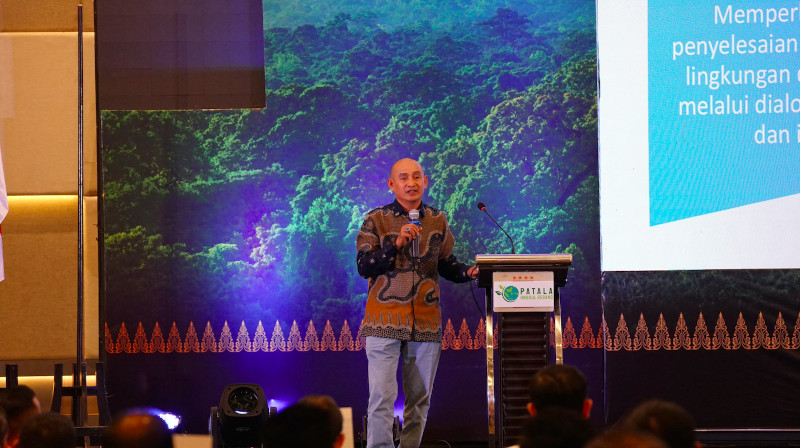
Mahir Takaka, a leading social expert, speaking at the dialogue in Pekanbaru, Riau
Mahir Takaka, a leading social expert, emphasised the program’s significance for corporate accountability in Indonesia, recognizing it as a framework for companies to strengthen social responsibility and safeguard forest sustainability.
Dr. Soeryo Adiwibowo, an academic/social expert from IPB University, acknowledged the complexities of the process but said that all parties should take advantage of the momentum.
“This is a momentum that could potentially lead to significant progress for the livelihoods of communities and the environment in Riau Province.”
The dialogue resulted in representatives from ten villages across four districts affirming their readiness to participate in the FSC Remedy process and engage in direct dialogue with APRIL Group.
This collaborative spirit was reinforced by local government officials, who committed to facilitating the ongoing process, and echoed by academics and civil society organizations, who welcomed the dialogue session as a foundation for fair, inclusive, and transparent engagement.
The first provincial stakeholder dialogue in early 2025 was followed by a series of landscape-level dialogues across four districts – Siak, Pelalawan, Indragiri Hulu, and Kuantan Singingi. These engagements aimed to build awareness of the FSC Remedy Framework and to build support from government institutions, civil society organizations, academics, and other key stakeholders for the remedy process.
Subsequently, community-level dialogues were held in ten villages, enabling rights holders to gain a deeper understanding of the remedy process, and assisting villages in identifying potential harms and feasible remedy options.
Mulia Nauli, Director, PT. Riau Andalan Pulp and Paper, the operating arm of APRIL Group, highlighted the company’s commitment to the implementation of the process.
“We will conduct a systematic review of the concerns and aspirations shared by the participants and will address them through our formal grievance mechanisms, ongoing corporate social responsibility programs or through the remedy process,” he said.